City of Melbourne · via Exco Partners · 2024
Design the agent. Then get the council to trust it.
One Microsoft Copilot pilot, two problems: a Copilot Studio agent that could answer council questions, and 75 staff who had to make Copilot part of the job.
Act one
The Agent.
The problem
Every question became a ticket.
The service desk carried a high volume of repetitive, self-serviceable questions: how do I set up my email signature, what's the process for an expense claim, who owns this enquiry. Staff had nowhere to self-serve, so every question queued behind every other question.
The agent
Skippy proved it. CoMpanion shipped it.
Skippy was the test agent, a quick build that showed council staff would tap a button before they'd type a question into the void. CoMpanion was the production agent that followed, answering IT, policy, process and general council questions for around 120 staff. I helped define its conversation design and contributed the suggested prompts that teach people what it can answer.
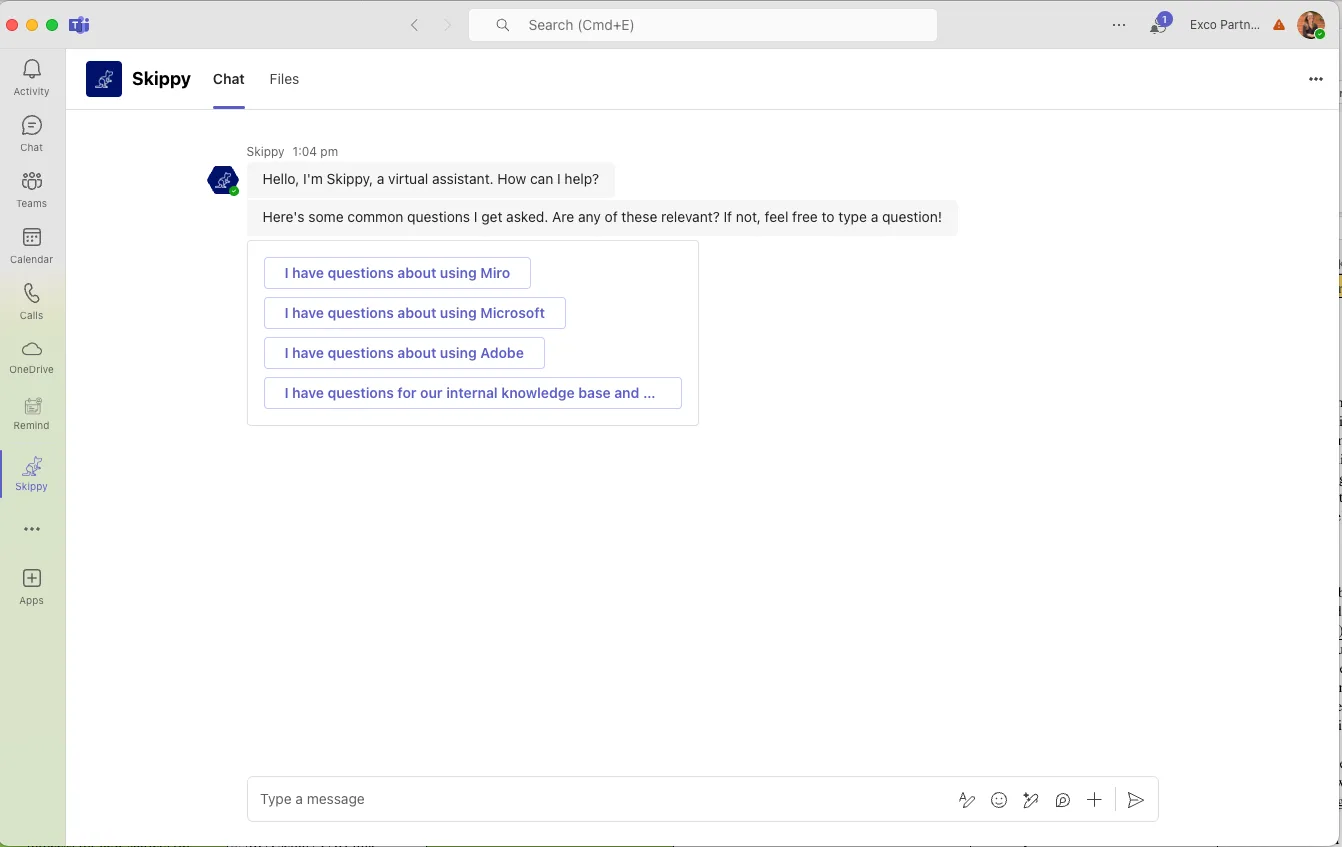
How a conversation resolves
Choose a path →
I need help with something.
Happy to help. Which of these is closest?
Starter prompt I contributed
How do I set up my City of Melbourne email signature?
Why it's worded this way
The highest-frequency self-serviceable ticket on the desk. First-person phrasing matches how staff ask, so the prompt teaches the question as well as the answer.
How it resolves
CoMpanion answers with numbered steps: the live email-signature reply comes back as a step-by-step list, not a wall of text.
Procedures return numbered steps
As in the live email-signature reply: steps in order, not paragraphs to decode.
Out of scope hands off
Anything the agent shouldn't answer, or that needs a human, routes to the Service Hub: trust but verify, built into the flow.
Quick replies carry forward
Skippy proved staff tap buttons. CoMpanion's three-button disambiguation keeps the pattern.
Impact
−40%
Ticket creation once CoMpanion was in service: the agent's outcome.
Act two
Adoption.
Adoption
Licences don't change behaviour.
A working agent and 75 Microsoft 365 Copilot licences change nothing if people don't use them well. The cohort had real council jobs, real deadlines, and tech literacy all over the map. My work on this stream was the enablement: role-based scenarios, a prompting framework, responsible-AI guidance, participant support and the pilot synthesis.
The design
Prompts that sound like the job.
Generic training bounces off. Each role got a scenario built from its own work: pick one.
“Summarise this stakeholder consultation thread into a one-page change-impact summary for the rollout. Group feedback by directorate, flag the three biggest adoption risks, give one mitigation each. Plain English, non-technical audience.”
The method
Goal. Context. Source. Expectations.
The framework behind every prompt in the pilot. Add each part and watch a weak prompt become a strong one.
Weak: a verb and a topic. Copilot guesses everything else.
Same bones, both streams: this framework shaped CoMpanion's suggested prompts and the 75-person training alike.
Responsible use
Council answers carry council consequences.
The responsible-AI guidance named the risks and trained the mitigations. Select a risk to see how it was handled.
Bias: the mitigation
Outputs checked for framing and terminology, with specific sensitivity to First Nations terminology. Flagged wording goes to a person, not out the door.
The lever
One-on-one beat the group session.
The retro's clearest finding: across a cohort with tech literacy all over the map, 1:1 support moved people that group training couldn't. Adoption, not tooling, was the hard part.
Legacy
It outlived the pilot.
75
Pilot participants enabled: role-based scenarios, prompting framework, responsible-AI guidance and 1:1 support: the enablement I designed.
Programme outcome
Exceeded every measure
The pilot exceeded all success measures and gave the City of Melbourne the evidence for a five-year business case.
Mine
The reusable baseline
My training materials became Exco's reusable baseline, picked up again for Melbourne Water and McConnell Dowell.
Still here? You're my kind of reader. There's more below.