Copilot at Melbourne Water.
A Microsoft 365 Copilot proof of concept: metrics defined before licences, with personas, use cases and hands-on workshops.
The Objectives
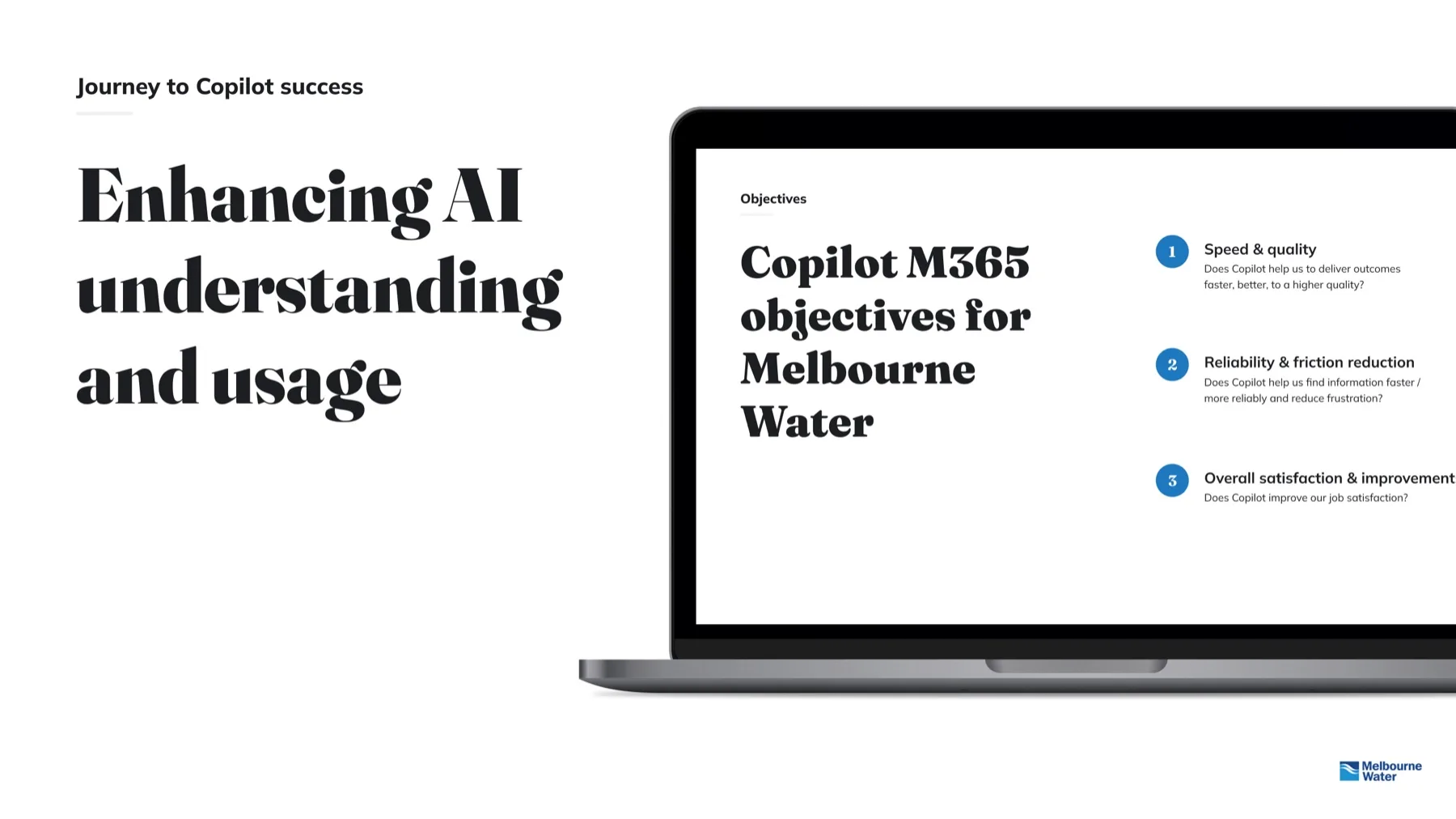
Three Questions the PoC Had to Answer.
Before anyone talked licences, the proof of concept was framed as three answerable questions, so "did Copilot work?" would have an evidence-backed answer.
Speed & quality
Does Copilot help us deliver outcomes faster, better, to a higher quality?
Reliability & friction reduction
Does Copilot help us find information faster and more reliably, and reduce frustration?
Satisfaction & improvement
Does Copilot improve our job satisfaction?
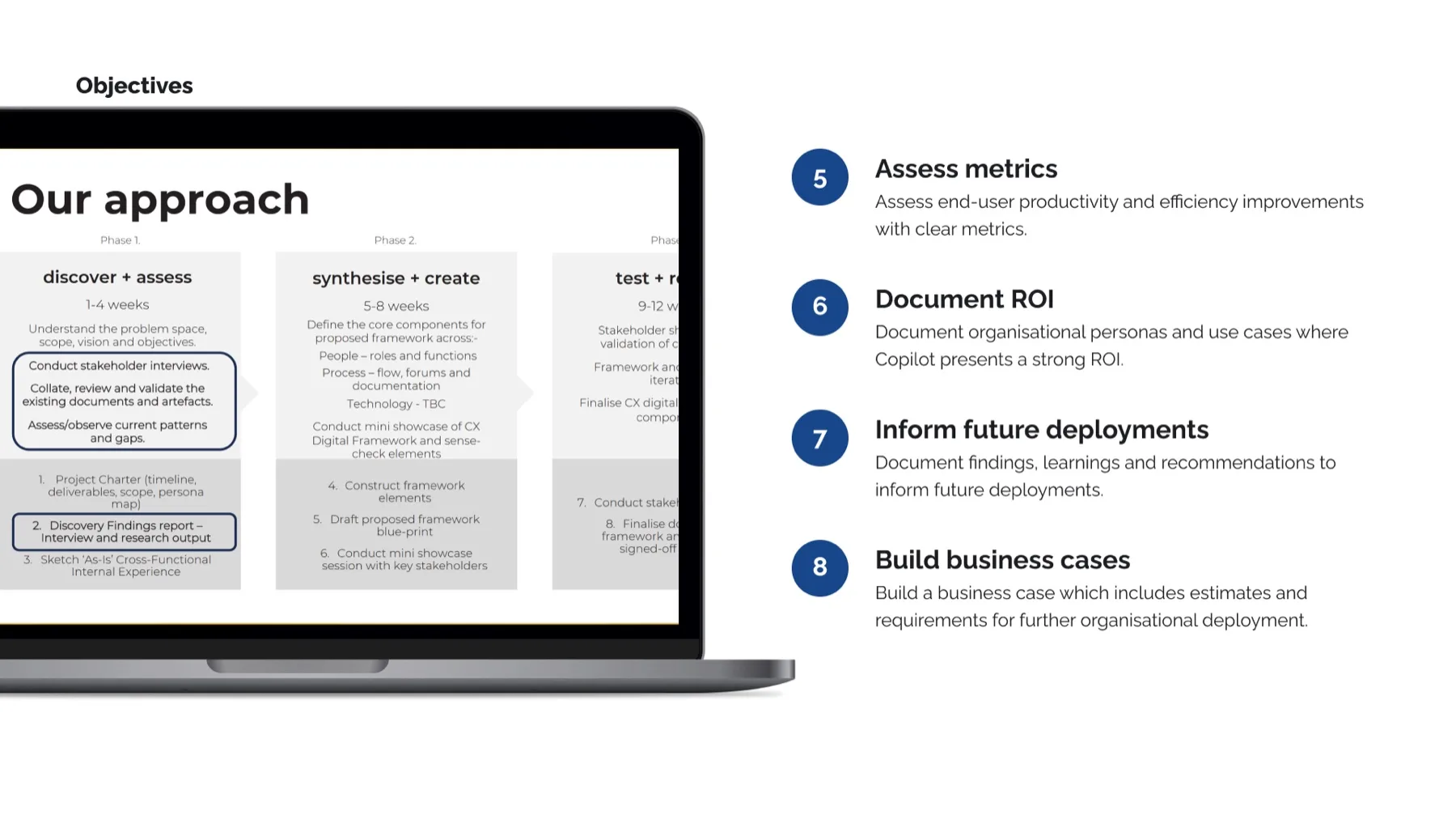
The Approach · 12 Weeks, 3 Phases
Discover, Synthesise and Test, With ROI and Business Cases Built In.
Eight objectives spanned the engagement, from stakeholder interviews and metric baselines through to documented ROI, findings to inform future deployments, and a business case for organisation-wide rollout.
Phase 1 · weeks 1–4
Discover + assess
Stakeholder interviews, validation of existing artefacts, and assessment of current patterns and gaps. Output: project charter and discovery findings report.
Phase 2 · weeks 5–8
Synthesise + create
The CX digital framework across people, process and technology, drafted as a blueprint and sense-checked in a mini showcase with key stakeholders.
Phase 3 · weeks 9–12
Test + refine
Stakeholder showcases, framework iteration, and the finalised, signed-off CX digital framework and components.
Discovery · Deliverables Defined by Metrics
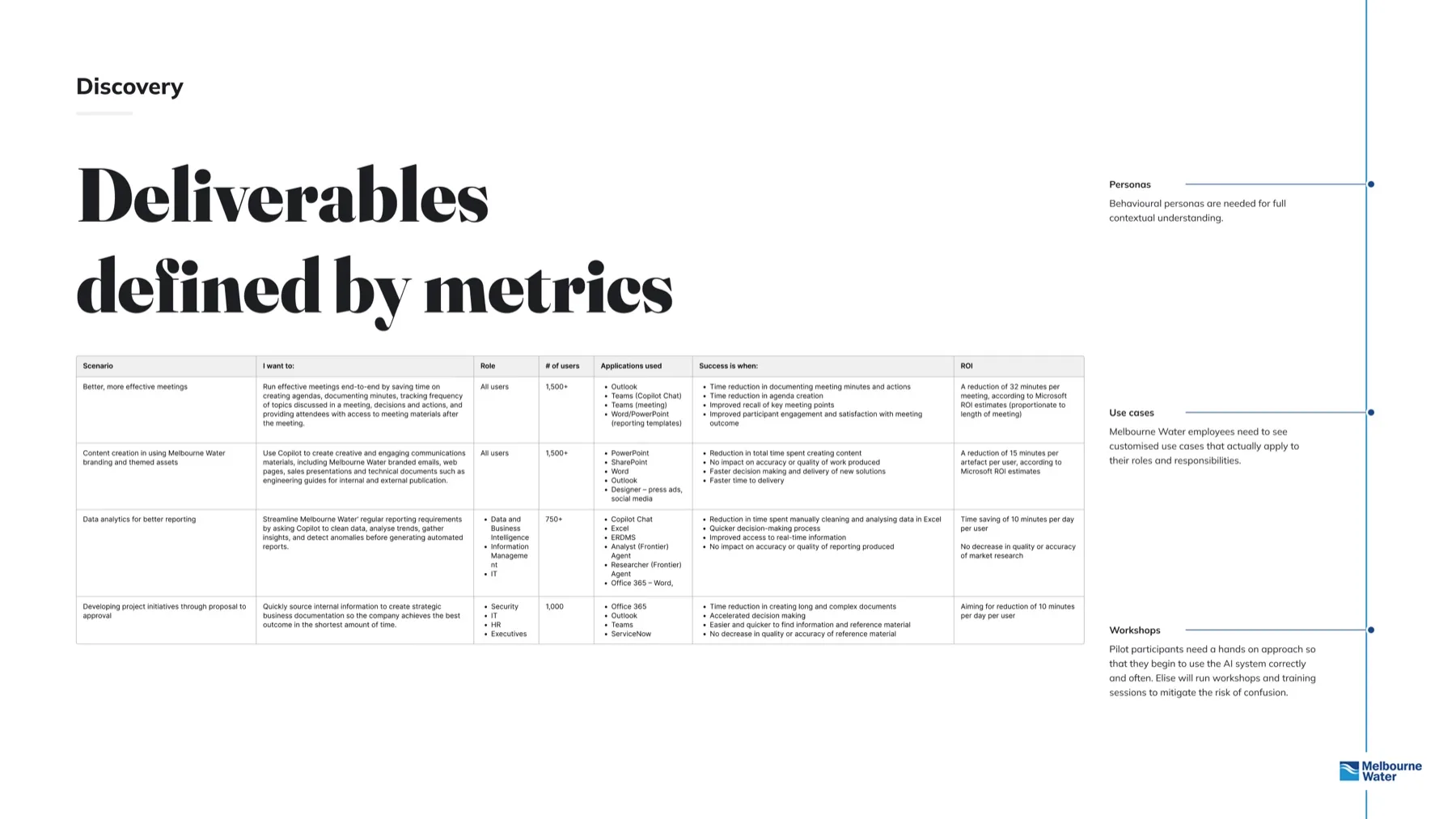
Every Scenario Got a Success Metric Before It Got a Licence.
Four working scenarios (meetings, content creation, data analytics and proposal development), each mapped to roles, applications, "success is when" criteria and a Microsoft ROI estimate. Personas, customised use cases and hands-on workshops closed the gap between licence and behaviour.
1,500+
Staff in scope for the meetings and content-creation scenarios.
−32 min
Per meeting: the ROI target for documenting minutes, actions and agendas.
4
Scenarios with defined roles, applications and "success is when" criteria.
Enablement · Journey to Copilot Success
Teaching the Prompt as Well as the Product.
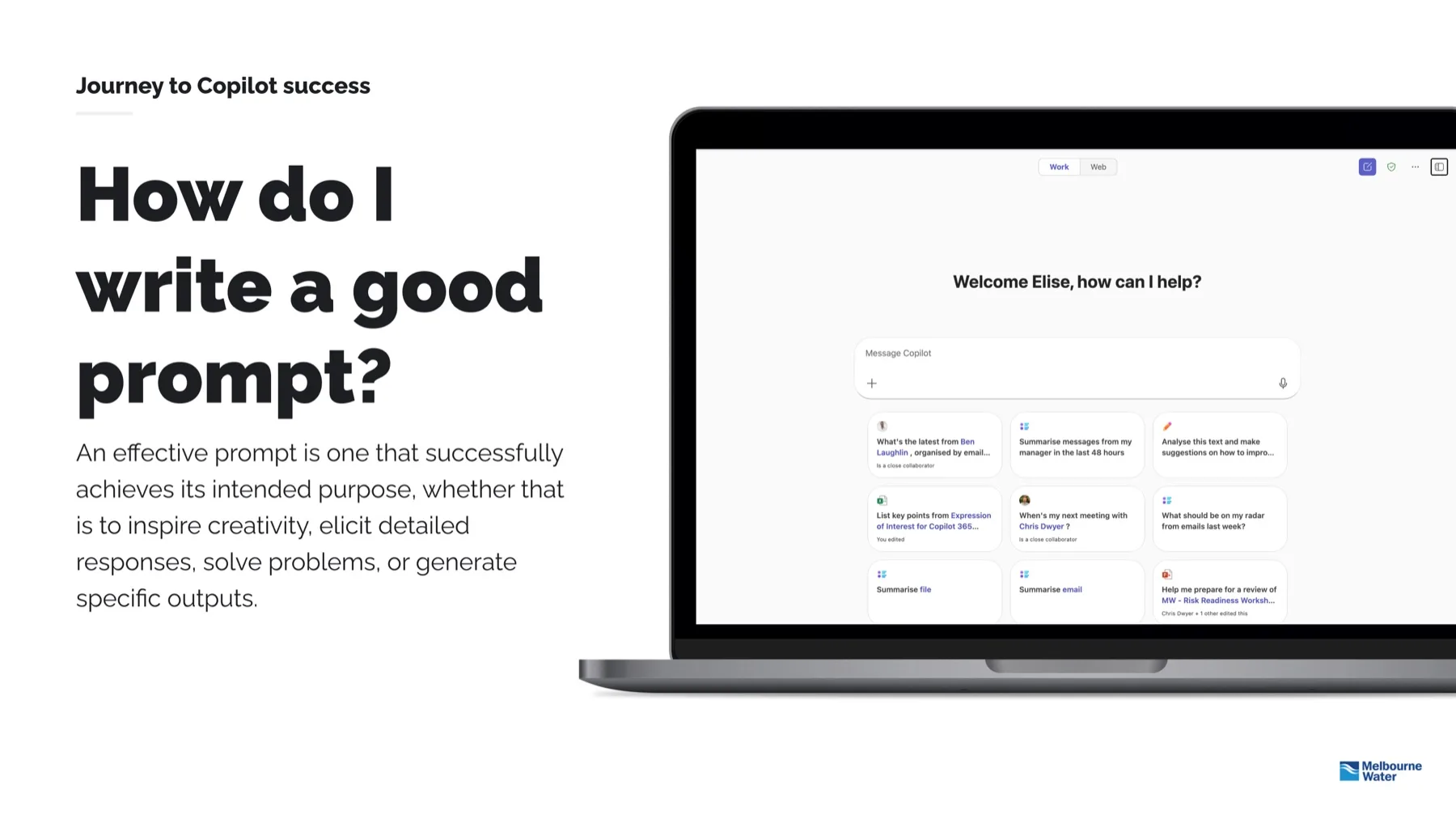
Seventy-odd staff went through the training: eight sessions on responsible AI and prompting, then one-on-ones. Technical literacy across that group went up 80%. The personas were behavioural, built around how someone's week ran and where generative AI could sit inside it, because adoption is a behaviour problem first. The wider rollout had 1,500+ staff in scope with a documentation target of 32 minutes saved per meeting.
+80%
Technical literacy, trained cohort.
70+
Staff trained across eight sessions.
An AI proof of concept earns its rollout when the metrics are set first, not counted afterwards.